By Dr. Paul Jehle (PRF President)
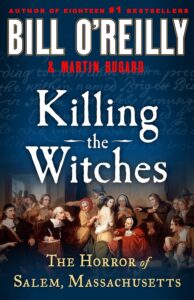
Bill O’Reilly’s “Killing” narratives are “the most popular series of narrative histories in the world.” So says the jacket cover on his latest. Though I have read some of them, and have generally enjoyed them, this one caught my wife’s attention first. She knew it would pique mine, since I spent hours researching the Salem Witch Trials around the time of its 300th anniversary in 1992. (1)
The book can be put into four sections:
– Chapters 1- 3 – the “Puritan” precedent of “religious tyranny and intolerance”
– Chapters 4 -17 – the religious tyranny of the Witch Trials “led by Increase and Cotton Mather”
– Chapters 18 – 26 – resistance to “religious intolerance” is the seed of our constitutional freedom
– Chapters 27 – 32 – today’s “witch hunts” continue where one is guilty until proven innocent
(1) The “Puritan” Precedent of “Religious Intolerance”
The Prologue opens the book with the 1591 burning of Dame Eupharne MacCalzean, who was accused of being a witch. The obvious implication is that the religious tyranny of James VI of Scotland will soon be transferred to the Puritans, who ironically flee the tyranny of England, yet impose a new tyranny in New England …foreshadowing the Salem Witch Trials, which would follow 70 years later.
In the first three chapters, there are numerous cracks in the book’s foundational premises. First, the Pilgrims of 1620 are brush-stroked as being identical with the Puritans. Though the distinctions are minimal theologically, the Pilgrims more clearly practiced freedom of conscience, as well as maintaining the jurisdictional separation of church and state. However, both Pilgrim and Puritan embraced the Common Law,(2) where due process (innocent until proven guilty) was practiced.(3)
Second, some “facts” that are either false or taken out of context have significant consequences, such as:
– Captain Jones decided to anchor the Mayflower in Plymouth Harbor; no, it was the congregation;
– Plymouth Rock is a complete legend with no evidence; this ignores the veracity of eyewitness accounts; (4)
– the idea that Plymouth is governed by “religious law” rather than civil law; sloppy scholarship; (5)
– Bradford shut down Merry Mount as a destruction of religious freedom; no, he shut down anarchy;
– Bradford didn’t work, but spent all day reading the Bible; this was a mockery of his faith;
– that moral punishments by civil law were an invention of the Puritans alone; this is false.
The presumed premise that religion, specifically Christianity, is the main source of tyranny in church and state is a fallacy. These assertions, and others, make for a shaky foundation of blaming religion, and especially the Christianity of the Puritans, for all the ills of modern hysteria and political tyranny. We have been told that the excluding of religious premises from intellectual thought is what developed individual rights, toleration of differences, limited government, and a desire for universal education. This is false.
Eric Nelson summarizes this fallacy: “These innovations could not appear on the scene until religion had effectively been sequestered from political science.” But he then states his refutation of this premise that “…the traditional story I have just sketched puts things almost exactly backward.” (6) In other words, it was the Biblical premises brought by the Pilgrims and Puritans that sought to correct European thought, producing the theories of law, government, and education adopted in the United States!
(2) The Religious Tyranny of the Witch Trials “led by Increase and Cotton Mather”
Anyone who reads the records of the trials and takes careful note of the response of the judges will quickly see that the manifestations of demonic bondage among the children were real and impossible to act out, but the judges accepting “spectral evidence” and presuming the accused guilty until proven innocent deflected the personal responsibility away from the parents and children, violating their own theology. Though some of these facts are sporadically covered in the book, it’s what is left out that is concerning.
Though the Biblical doctrine of the pastors, including Increase and Cotton Mather, was sound on the existence of demonic spirits, nature of the demonic kingdom, and Christ’s victory over it, they neglected the bitter roots and jurisdictional discernment necessary to combat it, utilizing the civil sphere almost exclusively to combat a spiritual enemy. The Massachusetts Body of Liberties, written by Nathaniel Ward and accepted in 1641, declared due process in Articles 1, 31 and 47, and should have governed how they tried a supposed witch (covered in the 2nd clause of Article 94 on Capital Laws.) Thus it was not the Puritan law that persecuted supposed witches; it was the Puritan judges who neglected to follow them!
The “judicial supremacy” of the judges who created rules from the bench to accept spectral evidence of witchcraft violated the common law they professed to follow. The fact that at least 10 of the 20 executed in Salem were leading Christian citizens (including godly intercessors) gives the entire episode a cloud of true spiritual warfare where deception appeared to reign supreme. But the book’s presumption is that believing in spiritual warfare was a major part of the problem. This is the fallacy of a red herring, for history must always be interpreted within the context of its time, not in the supposed wisdom of the present.
The common law embraced by the Puritans, drawn from the Bible, differed in practice from some of the English civil law they fled from. Several pastors warned them before and during the trials, including Increase and Cotton Mather. The assumption of the book is that it was Christianity that eliminated due process, when the question should be: “Why did the Puritan magistrates in Salem in 1692 abandon the very common law that brought individual liberty into both England and New England?”
Both Increase and Cotton Mather cautioned against the use of “spectral evidence” (dreams and visions), but were also hesitant to interfere with court proceedings. Cotton Mather utilized prayer and deliverance, successfully curing some demonized and recommending this for Salem. As Salem’s Witch Museum declares, “Though famously associated with the Salem Witch trials, Mather (Cotton) was only peripherally involved in the events of 1692.… Along with other notable Boston ministers, Cotton Mather had warned against the use of spectral evidence and advised caution from the onset of the trials.”
Increase Mather, his father, is the one who wrote, “It were better that ten suspected witches should escape, than that one innocent person should be condemned.” (7) Both Increase and Cotton, unfortunately, did not intervene more strongly against the use of the pagan inventions for determining a witch’s guilt. But the premise that the church generally ruled society in New England as tyrannically as the state ruled the church in England is simply false.
(3) Our Democracy and Constitution defeat the “religious tyranny” of the Puritans
Chapters 18-26 chronicle the story of our founding as a nation through the eyes of Ben Franklin and others as they rose to prominence in the early 18th century after the trials had concluded. What is left out or hardly covered is that:
– the Legislature set a day of fasting and repentance in 1697.
– Ann Putnam, the 12-year-old main accuser, apologized for her role in 1706 (and was forgiven).
– Pastor John Wise of Ipswich opposed the Mathers’ desire for centralized control of churches, asserting the same fundamental premises brought forth in the Reformation that laid the foundation for the common law. It is interesting to note that Wise’s works in 1710 and 1717, written to assert the liberty of the churches, were republished in 1772 by Sam Adams, providing a clear link from Puritan theology to the Declaration and other founding documents. (8) Samuel Mather, son of Cotton, wrote An Apology for the Liberties of the Churches in New England in 1738, where he asserts his agreement with Wise. (9)
The book overstates the “controlling influence” of Increase and Cotton Mather on the subsequent founders as if they were all reacting to a dominant strain of church control over society. Ben Franklin, John Adams, and Sam Adams were influenced by the clergy of their day, such as George Whitefield and others, who clearly articulated the seeds of religious liberty. The Great Awakening revived Puritan theology as well as personal conversion. It is important to note that changes in the civil sphere (such as dethroning state-sponsored denominations) often take at least one generation before such truths are made into law.
(4) Today’s “witch hunts”
In chapters 27-32, the book details the very sad story of Ronald Hunkeler’s battle with demonic bondage and manifestations, and how this became the inspiration for the Exorcist movie of 1973. Though living a somewhat normal life for decades since his teen years, his “personal demons” cost him his marriage and relations with his children until his death at 84 years of age in 2020. Not only did the film cause unusual manifestations among its actors and on set, it also aroused a curiosity in the occult within the rising generation. Billy Graham’s caution that “there is a power of evil in this film, in the fabric of the film itself” was not taken seriously at the time, nor is it in the book.
The “Author’s Note” states: “Today, there is a new kind of witch hunt. Accusations mean guilt. The press drives that every day. No one is executed, but lives are ruined in terrible ways. And there is no forgiveness for actual transgressions. The cancel culture makes sure of that. Demonization has cast a terrible fear across the land.” He also writes that “due process is often ignored in the court of public opinion. Denials never deter destroyers.”
Are today’s witch hunts caused by the same power that caused Salem’s? The book concludes that “there were no real witches in Salem in 1692.” It also concludes: “Fear has returned. It is a mirror of Salem. Many good people turn away from the cancel culture corruption rather than criticize it. There is an active evil in our country. It is present for all to witness. There are now thousands of cases of shattered lives, with more emerging every day. Something is generating all this. Something.” With no anchor of Biblical faith, the “something” is vague, and in the book, tragically, there is no clear cause or solution.
Conclusion
The very Christianity and theology, along with the Common Law, brought by the Pilgrims and Puritans to New England’s shores, laid the framework and foundation for the jurisdictional separation of church and state, as well as religious and civil liberty, that flowered 150 years later. The Pilgrims modeled these truths in greater measure ahead of their time, and though the errors of Puritan government of church over state occurred tragically in 1692, they misapplied their own theology, clouding their legacy. The Puritans did not “invent” civil law having a moral base; all law is moral and rests on a religious premise of some kind.
The Witch Trials of 1692 represent an aberration of Puritan practice. For nine months a form of “judicial supremacy” reigned in Salem where people were guilty until proven innocent, and “spectral evidence” was taken as legitimate in a court of law. This was not the norm but the exception. The repentance for the travesty and the reparations that followed were just. The liberty declared in our Declaration, and protected in our Constitution, was the result of what was preached in the pulpits of colonial America 150 years prior to the ratification of these documents.
Increase and Cotton Mather (among others), in their zeal for a holy commonwealth, embraced a measure of centralization of their churches. But a majority of Puritans would agree with the seeds laid in Plymouth and would correct the errors of those who sought greater control from 1680-1720. It is also necessary to point out that the loss of the Massachusetts’ Charter, and the Glorious Revolution, played a distinct role in creating cultural chaos at the very time the Trials took place.
One of the greatest challenges we have in America today is the discernment of cause and effect. If we reject the root of Christianity and its rule of law, thinking it is the cause of tyranny, we will be deceived by the very devil that we presume does not exist. We will not eliminate tyranny, but only switch tyrants. Globalism today is an enhancement of real tyranny that should alarm us all, as well as reveal the fact that there is a demonic kingdom and not merely individual devils. Furthermore, we must see all spiritual warfare in the context of Biblical theology, which, in agreement with the Puritans, would declare that personal sin opens the door to demonic activity and possible possession.
Just as a lack of true applied Christianity was the source of the travesty in Salem in 1692, so the law and the gospel are the answer, as Cotton Mather demonstrated – and repentance for sin, prayer, along with personal responsibility, are its main weapons. If that had been the focus in 1692, not one individual would have died in Salem – not because there was no real spiritual warfare, or that witches did not exist, but because one is innocent until proven guilty, and an invisible crime with no witnesses cannot be proven in court. The Common Law, if applied, would have eliminated the travesty of 1692, and would also eliminate the same tragedy of today’s “witch hunts.”
______________________________________
1) Jehle, Paul, “Spiritual War: The Salem Witch Trials of 1692;” Proclaim Liberty Journal, Heritage Institute Ministries, Volume 3: Issues 3-4, December, 1992.
2) There are numerous sources that identify the common law heritage of Puritanism in the foundation of New England. Brent Winters’ Excellence of the Common Law (2008) is a case in point where he defines common law as: a) seeing every civil magistrate as a minister of God, to Whom he is responsible; b) God alone is Lord of the conscience, thus the individual has freedom of conscience; and c) obedience to any command contrary to God’s desire is always wrong (page 17). See also Chapter 3, “Roman Civil Law in Common-Law England,” which was the heritage brought by the Pilgrims and Puritans to New England.
3) See also H. Wayne House, general editor, The Christian and American Law, Kregel Publications, 1998, and Harry S. Stout, The New England Soul, Oxford University Press, 1986 where he documents that the Covenant theology of the Puritans was the base for our constitutional liberties.
4) Jehle, Paul, Thomas Faunce: “the man who saved Plymouth Rock,” Plymouth Rock Foundation, February, 2020.
5) Jehle, Paul, Journey of Faith: Why the Pilgrims Came, Plymouth Rock Foundation, 2020, where I document, on page 54, that the Pilgrim government did not require church membership in order to vote in civil affairs, and that this jurisdictional separation of church and state eventually was adopted by all the colonies, notwithstanding some Puritans holding to franchise suffrage.
6) Nelson, Eric., The Hebrew Republic, Harvard University Press, 2010, page 2.
7) Cotton Mather: Villain, Bystander, or Somewhere in Between? Salemwitchmuseum.com
8) See Jehle, Paul, “The Origin of the Declaration,” Plymouth Rock Foundation E-News, July, 2011.
9) Dexter, Henry Martyn, The Congregationalism of the Last Three Hundred Years, 1880, as published in Hall, Verna’s The Christian History of the American Revolution: Consider and Ponder, page 103.