
Transition is inevitable. It will touch all of us, especially when it involves the death of a mentor. The disciples of Jesus had to face His departure. He said, “I tell you the truth. It is to your advantage that I go away.” Though they did not want to hear this, the reason was, “If I do not go away, the Helper will not come to you” (John 16:7). Jesus’ death, resurrection, and ascension was the greatest of all transitions. By God’s design, the Kingdom of Christ would expand throughout the world because of the Holy Spirit’s work decentralizing God’s Kingdom due to the King living in His subjects. Christianity’s cornerstone is self-government. The legacy of the one who has mentored and led us is the hope of transition. That legacy is the influence of those who embrace what they have learned with increased perseverance.
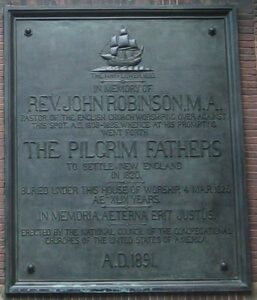
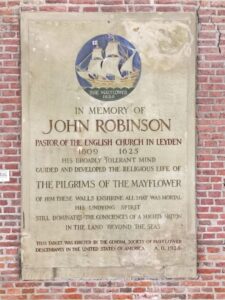
 The writings of John Robinson are filled with his understanding of this great principle of transition through the power of loving service and self-government. He upended the distortion of the governmental flow of power residing in the bishops of his time. Robinson died March 1, 1625, and it was not until many months later that a letter written April 28 from Roger White, a member of the Leiden Congregation, was received by the Pilgrims in America. Robinson had been buried many months before in the Pieterskerk (St. Peter’s Church) in Leiden, Holland. Roger White wrote in his letter:
“…It hath pleased the Lord to take out of this vale of tears, your, and our loving, & faithful pastor, and my dear, & Reverend brother Mr. John Robinson, who was sick some 8 days; he began to be sick on Saturday in the morning, yet the next day (being the Lord’s Day) he taught us twice. And so the week after grew weaker, ever day more than other, yet he felt no pain, but weakness all the time of his sickness… sensible to the very last… He fell sick the 22nd of February and departed this life the 1st of March… all his friends came freely to him… if either prayers, tears, or means, would have saved his life, he had not gone hence. But he having faithfully finished his course, and performed his work which the Lord had appointed him here to do, he now resteth with the Lord in eternal happiness.”
 Grief is not always easy to manage but often accompanies the passing of the torch. White writes, “We wanting him, & all church Governors yet we still (by the mercy of God) continue, & hold close together, in peace, and quietness, and so hope we shall do, though we be very weak.” Since the church in Leiden had sent its best to plant a church in Plymouth, it gradually declined after Robinson’s death, with Bridget, and others, taking refuge in other reformed churches. As Bradford wrote, “Their other friends from Leyden writ many letters to them, full of said laments for their heavy loss; and though their wills were good to come to them, yet they saw no probability of means how it might be effected, but concluded as it were that all their hopes were cut off. And many, being aged, began to drop away by death.” So, what lessons can we learn from Robinson’s death 400 years later?
 First, Robinson’s applied theology to church and state and the cultural issues facing his congregation established those in his congregation with an ability to be self-governed. Bradford writes, “For, besides his singular abilities in divine things (wherein he excelled) he was also very able to give directions in civil affairs, and to foresee dangers, and inconveniences; by which means he was very helpful to their outward estates.”
Second, Robinson’s example of Christian character caused many to be drawn to him and the church, for Bradford writes, “His love was great towards them, and his care was always bent for their best good, both for soul and body.”
Third, he prepared them for transition, for he was not going with them to the new world. As his farewell sermon revealed, he told them to “follow me no further than I follow Christ,” for there is great danger of “going no further than the instrument of your reformation.” In other words, don’t allow respect and love to become idolatry, stunting growth. “If God should reveal any thing to us by any other instrument of his… be as ready to receive it as you have been to receive from me.”
Fourth, he taught them how to study the Bible for themselves. Robinson told them to “receive whatsoever light and truth shall be made known to us from his written Word… but take heed… to examine and compare it and weigh it with other Scriptures of truth before receiving it.”
 Fifth, he taught them how to daily walk with God.
– “…To daily renew our repentance with our God, especially our sins known, and generally for our unknown trespasses” to be at peace with God and our conscience.
– “We carefully provide for peace with all men what in us lieth, especially with our associates.” This involved not “giving offense” and to avoid, if possible, “taking offense.”
– In relation to strangers and those you do not know as well, use “wisdom and charity for the covering and preventing of incident offenses.”
– To avoid “taking offense at God Himself… in our crosses, to bear impatiently such afflictions as wherewith He pleases to visit us.”
– “With your common employments you join common affections truly bent upon the general good, avoiding as a deadly plague …for proper advantage… Let every man repress in himself and the whole body in each person, as so many rebels against the common good, all private respects of men’s selves, not sorting with the general conveniency.”
– Since they were going to set up a civil government, and frame just and equal laws, in voting “let your wisdom and godliness appear, not only in choosing such persons as do entirely love and will promote the common good, but also in yielding unto them all due honor and obedience… as God’s ordinance for your good.”
Finally, Robinson successfully had his followers receive his ideas at a deep level so they in turn could pass them on to others. His fifth son, Isaac, came to New England, helped to start the towns of Barnstable and Falmouth, stood up for Quakers, and lived among the Natives on Martha’s Vineyard as a public official. Eventually, his legacy was the seed of liberty under law. He was, as I have called him, the Shepherd of America. Each of us should strive to have the kind of impact and influence John Robinson did, for we enjoy the fruit of his ministry today, yet many do not even know his name! Oh, that God would have us see our mentors as God sees them, and may Pastor Robinson inspire us to do so!