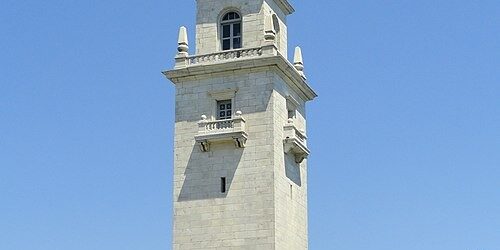
 March 17 is well known to most Americans as St. Patrick’s Day. While this is an important day that commemorates some of the deepest Christian roots in our nation, another event took place on the same day in 1776 that helped set the stage for independence. This drama included the fortification of Dorchester Heights. A large monument, 115 feet high, dedicated March 17, 1902, preserves this amazing miracle. It is also known as the British Evacuation of Boston after they had laid siege to the town for over 10 months following the Battles of Lexington and Concord the previous year.
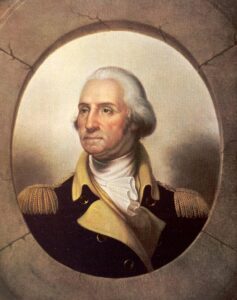 After being commissioned as Commander in Chief, George Washington arrived in Cambridge on the 2nd of July and surveyed the thousands of militiamen that had come from throughout New England. The autumn and winter dragged on with little activity, so both the British and the American militias simply “dug in.” The British were surrounded but had little respect for the militia that had pelted them along the roads of Lexington and Concord, and finally were subdued at great cost to them at Bunker’s Hill.
 Faneuil Hall in Boston, known as the “Cradle of Liberty,” had been turned into a theater by the British. A play entitled The Blockade of Boston, written by General John Burgoyne, was planned to begin at 9 PM on January 8 of 1776. It was a satire on the “rebels,” portraying Washington as a drunken idiot dragging a rusty sword. At that moment, a hundred American militia attacked the British outpost at Cambridge. Jack Manning writes:
“One soldier, dressed in a costume and about to perform, rushed onto the stage and yelled out that the rebels were attacking. The… soldiers believed the outburst was part of the performance…. After [realizing] they were truly under attack…eyewitness accounts have the soldiers tripping over each other, jumping over the orchestra pit, stomping on violins, rushing to change from their costumes and wipe the makeup off their faces in order to get to their posts. The Americans had quite a laugh at the scene when it was reported in newspapers a few days later.”
On January 25, a providential event lifted the spirits of the Americans. Henry Knox, a 25-year-old bookseller, came into Boston having dragged 59 cannons, mortars, howitzers, lead and flint (over 60 tons) 300 miles in 56 days from Fort Ticonderoga! This was the encouragement Washington needed, for once the Heights could be fortified, an advantage over the British might result in forcing them out of Boston. Knox had written to Washington on December 17, 1775 that “three days ago it was very uncertain whether we could have gotten them until next spring, but now please God they must go…. I hope in 16 or 17 days’ time to be able to present to your Excellency a noble train of artillery.”
Washington issued an order on February 26 to get “all the Axes—Pick-axes—Spades—Shovels, and other intrenching Tools,” with this caveat, “At this time of public distress, men may find enough to do in the service of their God, and their Country, without abandoning themselves to vice and immorality.” Adding to his warning about these distractions, his order on the next day was sober but inspiring:
“It is a noble Cause we are engaged in, it is the Cause of virtue and mankind, every temporal advantage and comfort to us, and our posterity, depends upon the Vigor of our exertions; in short, Freedom, or Slavery must be the result of our conduct, there can therefore be no greater Inducement to men to behave well. Next to the favor of divine providence, nothing is more essentially necessary to give this Army the victory of all its enemies, than Exactness of discipline.”
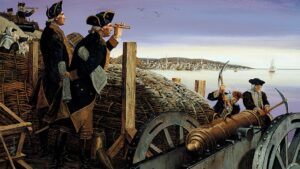 On Monday, March 4, the fortifications of Dorchester Heights began. Some 300 wagons, 1,200 men, and supplies arrived on the frozen hill where men would dig all night through 18 inches of frozen earth. At the same time, a cannonade on the opposite side of town was kept up with the British to cover their actions. The morning of March 5 brought a shock to the British! General Howe said, “The rebels… have done more work in one night, than my whole army would have done in one month!”
Washington watched with anxiety, saying, “When the enemy first discovered our works in the morning, they seemed to be in great confusion, and from their movements, to intend an attack.” General Howe decided to attack at night. Irving describes what happened:
“Twenty-five hundred men were embarked in transports, which were to convey them to the rendezvous at Castle Williams. A violent storm set in from the east. The transports could not reach their place of destination. The men-of-war could not cover and support them. A furious surf beat on the shore where the boats would have to land. The attack was consequently postponed until the following day. That day was equally unpropitious. The storm continued, with torrents of rain. The attack was again postponed. In the meantime, the Americans went on strengthening their works; by the time the storm subsided, General Howe deemed them too strong to be easily carried….”
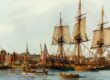
The Hand of God was noted here, as it was throughout the Revolution. The evacuation began at 4 AM on Sunday, March 17, and was done in haste under the threat of the British burning Boston. British soldiers broke into stores and demanded to have the inhabitants give them supplies. By 10 AM, the 78 ships and transports, and the 11 to 12,000 British (and Tories), had departed in overloaded boats.
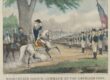
On March 18, Washington entered Boston by a route later dubbed “Washington Street.” As one remarked, “In the course of a few months, an undisciplined band of husbandmen became soldiers, and were enabled to invest, for nearly a year, and finally to expel a brave army of veterans, commanded by the most experienced generals.” This was another miracle of Providence.
 After a motion by John Adams, the Continental Congress unanimously thanked General Washington, striking a gold medal to commemorate the evacuation. On one side is a bust of Washington as the “Defender of Liberty.” On the other, it states, “For the first time the enemies are put to flight.” Washington responded to John Hancock:
“I beg you to assure them, that, it will ever be my highest ambition to approve myself a faithful Servant of the Public; and that, to be in any degree instrumental in procuring to my American Brethren a restitution of their just rights and Privileges, will constitute my chief happiness.”
Oh, that we would have such public servants again, whose “highest ambition” is to be faithful to protect rights!