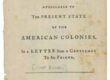

 Thomas Paine’s Common Sense, published anonymously in January of 1776 (250 years ago), ignited the people of the 13 colonies in a way that was truly remarkable. It was like a spark that brought to a flame the deeply held beliefs and principles already resident in colonial minds and hearts. It became an instant bestseller, with 120,000 copies being sold in the first three months. In its first year, over 500,000 had sold (20% of the population of the colonies). Some historians go so far as to say that Paine and his Common Sense were the primary inspiration for the movement toward independence and the writing of the Declaration. But this claim neglects the real biblical inspiration for liberty declared from the colonial pulpits that Paine borrowed without giving full credit to their source.
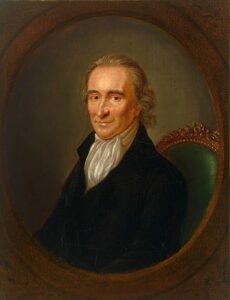 So, who was Thomas Paine? Pain (he would add the “e” later) was from Thetford, England, and arrived in Philadelphia in November of 1774 at 37 years of age. He was raised by his Quaker father and Anglican mother. After his basic schooling, he was “unsuccessful and unhappy” at every job he tried. In addition, he had two brief marriages which did not end well. After meeting Ben Franklin in London, he was encouraged to come to America. He then helped Robert Aitken start the Pennsylvania Magazine, which he edited for 18 months. Paine realized that his ideas would be more readily accepted if he adopted the verbiage of biblical truth.
As Isaac Kramnick wrote in his introduction: “The publication of Paine’s Common Sense could not have been better timed.” Despite Paine’s shortcomings, God used his bold nature. Benjamin Rush, physician and statesman who would sign the Declaration seven months later, encouraged Paine to write the book, changing its name from Plain Truth to Common Sense. He noted: “It burst from the press with an effect which has rarely been produced by types and papers in any age or country.” At the time of its publication, few would have voted for independence. Also, King George III’s speech to Parliament reached the Colonies at the same time, declaring them “in rebellion” and cutting off reconciliation.
Paine addresses four topics in his treatise. First, in Of the Origin and Design of Government in general, with concise Remarks on the English Constitution, he writes that: “Government even in its best state is but a necessary evil; in its worst state an intolerable one… the palaces of kings are built on the ruins of the bowers of paradise. For were the impulses of conscience clear, uniform, and irresistibly obeyed, man would need no other lawgiver; but… surrender(s) up a part of his property… security being the true design and end of government.” Paine here rehearses the logic of John Locke about the state of nature and the purpose of government protecting property. He states what was preached from the pulpits about conscience and its latent deficiencies (though not stating it is due to our sin nature).
Second, he addresses Of Monarchy and Hereditary Succession. He writes: “Mankind being originally equals in the order of creation, the equality could only be destroyed by some subsequent circumstance…. Male and female are the distinctions of nature, good and bad the distinctions of Heaven; but how a race of Men came into the World so exalted above the rest, and distinguished like some new species, is worth inquiring into, and whether they are the means of happiness or of misery to mankind.” Paine rehearses that Kings are not God’s original design, and that Israel choosing a King was borrowing from the “heathens.” He further states: “And when a man seriously reflects on the idolatrous homage which is paid to the persons of kings, he need not wonder that the Almighty, ever jealous of his honor, should disapprove of a form of government which so impiously invades the prerogative of Heaven.”
 Third, in Thoughts on the present State of American Affairs, Paine writes: “It hath been reported of the late Mr. Pelham… that on his being attacked in the House of Commons… replied that ‘they will last my time.’ Should a thought so fatal and unmanly possess the Colonies in the present contest, the name of ancestors will be remembered by future generations with detestation.” Paine rehearses the lesson of Hezekiah, who was willing to sell future generations into slavery for “peace in my days.” He challenges those desiring reconciliation: “I challenge the warmest advocate for reconciliation, to show a single advantage that this Continent can reap, by being connected with Great Britain.” He also challenges those who are neutral: “It is the good fortune of many to live distant from the scene of sorrow… but let our imaginations transport us for a few moments to Boston; that seat of wretchedness will teach us wisdom.” He closes with “in America, THE LAW IS KING.”
Fourth, in Of the present Ability of America, with some miscellaneous Reflections, Paine writes: “I have never met with a man, either in England or America, who hath not confessed his opinion, that a separation between the countries, would take place one time or other… As all men allow the measure, (independence) and vary only in their opinion of the time… we need not go far, the inquiry ceases at once, for, the time hath found us.” Paine makes his final point – we must declare independence now!
Paine rode the wave of Christian sentiment that existed long before he arrived on the scene. If his Age of Reason had been published before Common Sense, few would have read the 1775 book. John Adams’ response to Paine was to write Thoughts on Government in April of 1776, delineating a true republican form of government. Gary DeMar quotes Adams’ diary entry in 1796 in response to Paine: “… Let the Blackguard Paine say what he will; it is Resignation to God, it is Goodness itself to Man.”
Sam Adams wrote, “When I heard you had turned your mind to a defense of infidelity, I felt myself much astonished and more grieved that you had attempted a measure so injurious to the feelings and so repugnant to the true interest of so great a part of the citizens of the United States.” Adams also stated, “Do you think that your pen, or the pen of any other man, can unchristianize the mass of our citizens, or have you hoped of converting a few of them to assist you in so bad a cause?”
Even Ben Franklin wrote, “He that spits against the wind, spits in his own face… burn this piece before it is seen by any other person… if men are so wicked with religion, what would they be if without it….” Paine’s Age of Reason, where he articulated his true beliefs about religion, was refuted by Elias Boudinot, a true Founding Father. His book, in response to Paine’s was The Age of Revelation. His thesis was simple: Paine elevated reason as God, whereas the believer elevates the Bible over reason.
So, what lessons can we learn? God often uses non-believers, as He demonstrates in Scripture, to stir up the passion of believers to do what is right, for He works all things out for good. May we see beyond the immediate and recognize that God is truly Sovereign and that, beneath the surface of events, He is continually advancing His Kingdom on earth as it is in heaven!