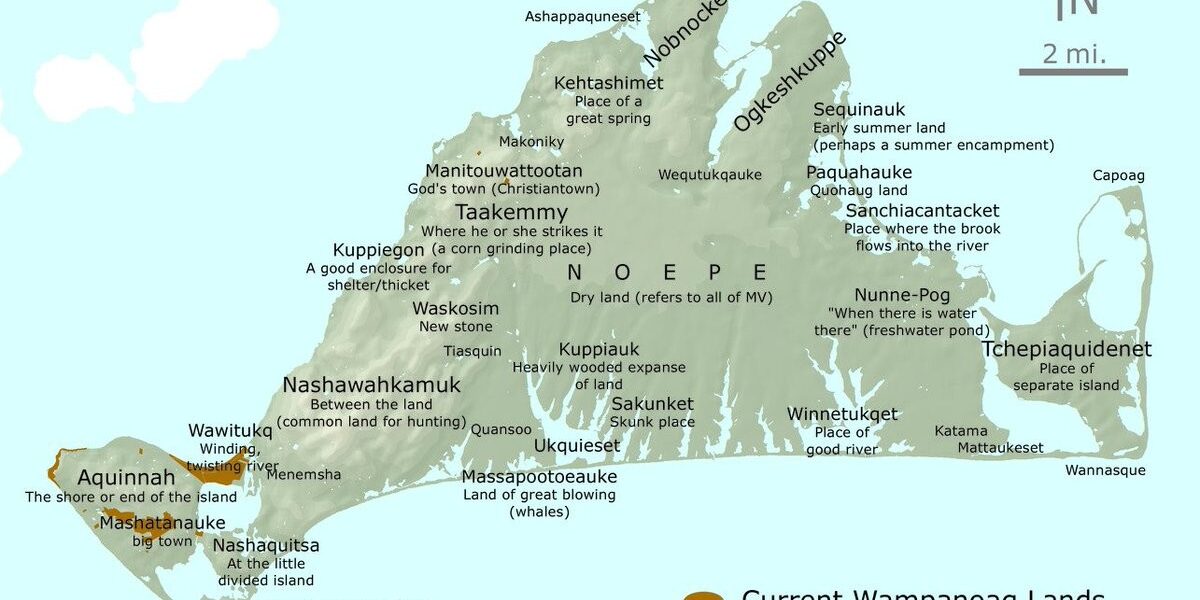
 The Wampanoag named this island “Noepe,” meaning “dry land.” Bartholomew Gosnold named it Martha’s Vineyard in 1602. As Bo Van Riper has documented, Thomas Mayhew, Sr. purchased the island in 1641 “to convert wealth… into land.”
He did his due diligence to make sure he paid off those who had previously laid claim to the island, but also “dealt fairly with the Indians, paying them fair market value for their land, and getting everything down in writing… as evidence that he cared about their rights and well-being.”
The actions of Mayhew, Sr.’s son, Thomas, Jr.; grandson John; and great-grandson Experience seemed to reject the “doctrine of discovery” idea that had given missionaries a bad reputation due to the Papal Bulls of 1452, 1455 and 1493, giving permission to “Christian” explorers to seize land and take dominion of nonbelievers with no regard for their rights.
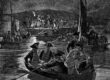
Thomas Mayhew, Sr. sent his son, Thomas, Jr., to plant a colony. They landed at “Great Harbor,” or what is now Edgartown. Thomas, Jr. insisted that all whites purchase land from the natives, in line with his father’s wishes. Thomas, Jr. began his evangelistic work soon after 1642 at 21 years of age. His first convert, Hiacoomes, was from Chappaquiddick. Experience Mayhew writes that his “countenance was not very promising.” Upon his conversion, he was persecuted for associating with the English. He replied, “I had one Hand for Injuries, and another Hand for God; whilst I received Wrong with the one, I laid the faster hold on God with the other.”
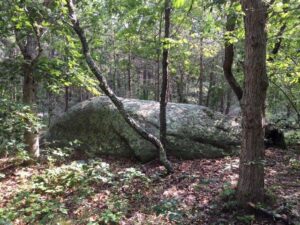 The next winter, a terrible sickness killed many natives, but Hiacoomes’ family was not touched. This was taken as a providential act of God after he read Psalm 91 following his conversion. He then joined the church. Thomas, Jr. began to learn the natives’ language from Hiacoomes. The converts began to multiply. By 1648, Thomas, Jr., along with Hiacoomes, began to preach at “pulpit rock” at Farms Neck in Oak Bluffs. They would spend half the night telling native children Bible stories, asking them questions, and making sure they understood biblical doctrine.
 On January 11, 1651, Mayhew, Jr. started the first Indian school on the Vineyard. He hired Peter Folger (grandfather of Benjamin Franklin) to be the teacher, who found the natives to be “very quick to learn and willing to be instructed.” Thirty enrolled, and six years later, four were ready to enter Harvard!
In 1657, at age 37, Thomas Mayhew, Jr. desired to go to England to report his work. He also wanted to purchase books and bring back ministers and teachers. Over half the 3,000 Indian inhabitants had been converted, and thus he needed help in discipleship. Sachem Sanchakantackett gave him a big “pow-wow” at Farm Neck before he left. His last meeting with his 1,500 converts was at a place between Edgartown and West Tisbury known as the “place by the wayside.”
They formed a giant semi-circle surrounding where he stood. He opened in prayer and preached from Psalm 1 and 23. A song was then sung. He then gave the leadership over to Peter Folger. Hiacoomes came forward and shook his hand, burst into tears, and placed a white stone at his feet, saying, “I put this stone here in your name, and whenever I pass, here I shall place a stone in your memory until you return.” Mayhew stated, “Hiacoomes, not in my name, nor in my memory; but in the name and memory of the Great Master of whom I have taught you – Christ.” All the chiefs present then placed a stone where Mayhew stood and, throwing their blankets over their faces, marched in sorrow to their homes.
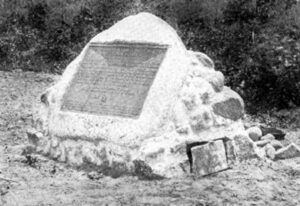 This place became famous when Mayhew’s ship was never heard from again. Natives continued to put white stones upon this mound whenever they passed, saying a prayer and remembering their Savior and the one who had brought them the good news of the gospel. The stone monument was erected by the Indians of Gay Head and dedicated in 1901. This is a unique monument, erected by the natives in grateful memory of the gospel of Christ and those who had brought that message.
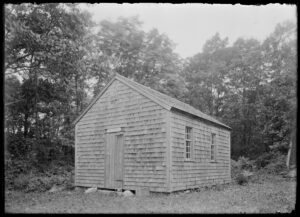 So great was the number of converts and the need to protect their rights that Christiantown, a one-mile-square town for converted natives, was founded in 1659. A small chapel was built, and they had a burial ground where the dead were interred sitting up facing East for the resurrection at Christ’s return! Though Thomas, Jr. was gone, John, his son, continued the work with his grandfather, Thomas, Sr. Experience Mayhew, his great-grandson, compiled the testimonies of many of the converted natives, documenting the revival that reported “not one unconverted native” by 1670.
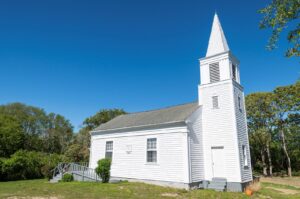 The First Indian Church was established in 1670 at Gay Head. Hiaccoomes was ordained as minister with John Tackanash. The island, guarded by Christian Indians, refused King Philip’s invitation to fight the English in 1675. At one point, King Philip came to the island, but when he was arriving, he saw armed Indians lined along the shore. They would not allow him to recruit anyone to fight!
 Pastor John Robinson sent the Pilgrim Church to America in 1620. He and Bridget had eight children. Isaac, their fifth, arrived in 1631, carrying his father’s legacy of humble service in his heart. He helped found the towns of Barnstable (1637) and Falmouth (1661). He stood against the persecution of Quakers at great risk. He moved to Martha’s Vineyard in 1671 and built his home in 1673, which still stands. He served as selectmen, extending the legacy of his father in particular and the Pilgrims in general.
So what shall we say of Noepe (or Martha’s Vineyard) which could be dubbed “the island of revival?” It is a unique place where revival continued for many decades as a result of loving, humble service to advance the welfare of the natives. This was a noble effort and an example of godliness that is too often the exception rather than the rule. The drama that continues during the ministry of Experience and beyond is one you will not want to miss in part 2 next month!