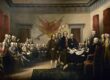
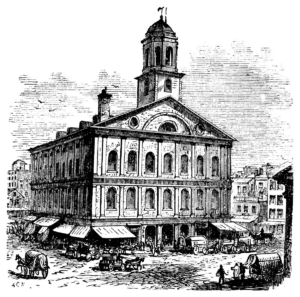
 On August 2, 1826, on the 50th anniversary of the signing of the Declaration, Daniel Webster spoke at Faneuil Hall in Boston, giving a eulogy of Thomas Jefferson and John Adams, who had both passed away on the 50th anniversary of the Declaration of Independence, July 4, 1826. Jefferson was 83, and Adams was 90. Webster proclaimed:
“…on the day which had fast linked forever their own fame with their country’s glory, the heavens should open to receive them both at once. As their lives themselves were the gifts of Providence, who is not willing to recognize their happy termination, as well as in their long continuance, proofs that our country and its benefactors are objects of His care?”
The Providence of God is the first thing Americans ought to remember when celebrating our nation’s 250th anniversary. The deaths of Jefferson and Adams on the 50th anniversary helped to shock the nation into seeing God’s Hand as the primary miracle that allowed the Declaration to be written. John Adams wrote in 1818 that “the Revolution was in the minds and hearts of the people, a change in their religious sentiments of their duties and obligations.”
The word Providence, when used by those at the time, was a synonym for the God of the Bible as the Creator of all. Though the ideas in the Declaration were articulated by 1700 in general and more specifically by 1763 from the pulpits of colonial America, the Great Awakening brought about a rekindling of these fundamental thoughts, for only God can truly change the hearts of people. George Whitefield was considered by many to be “America’s Spiritual Founding Father.” He did not invent the ideas, but they were brought alive by the Spirit of God moving in the hearts of the people.
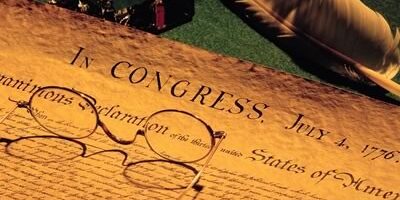
The Declaration mentions God four times specifically, and once by clear implication: “the laws of nature and nature’s God,” “endowed by our Creator with certain unalienable rights,” appealing to the “Supreme Judge of the World,” “the protection of Divine Providence,” and finally, “all men are created equal.” It was John Adams who wrote to Thomas Jefferson in 1813, stating:
“The general Principles, on which the Fathers achieved independence, were the only principles in which, that beautiful assembly of young gentlemen could unite…. And what were these general principles? I answer, the general principles of Christianity….”
Americans should also, on this 250th anniversary, remember the reason we declared independence. It was not because we disliked England, the King, or the amount of taxes, though all these were concerns. It was also not because we wanted to keep racist slavery, or that wealthy white landowners wanted to keep their money, as more modern diversions assert. The primary reason we declared independence was constitutional; King George III and Parliament violated the written charters of the Colonies.
 Since the Charter of 1606 clearly stated the initial rights of Englishmen, those same rights were repeated during the “constitutional debate period” from 1765-1775 in the various responses of the colonists to the unconstitutional demands of England. We believed we had the same rights and liberties as Englishmen, “just as if we lived in the homeland.” Our rights were God-given and resided in all subjects. So after a “long train of abuses,” following due process, we exercised the right of seceding from the British Empire.
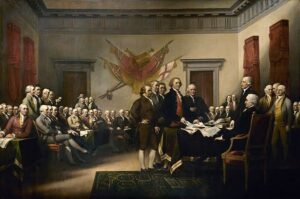
Third, Americans should remember the kind of liberty we fought for. We were not fighting for “the right to do what we want because no one could tell us what to do.” This is anarchy and is impossible to practice. Government is needed to “secure these rights by the consent of the governed.” Liberty is freedom from unnecessary control but is not absolute. It is always “under law.” The best expression of civil liberty is self-government. The more self-government we exercise, the less external government we need. But the key is which law will we be controlled by? The Bible was the source of the virtue (moral code) that guided the law of liberty. The delegates agreed with Sam Adams:
“A general Dissolution of Principles & Manners will more surely overthrow the Liberties of America than the whole Force of the Common Enemy. While the People are virtuous they cannot be subdued; but when once they lose their Virtue they will be ready to surrender their Liberties to the first external or internal Invader.”
 Fourth, Americans need to remember how we fought for our liberty and resisted tyranny. Faced with passive submission to tyranny or the more common direct rebellion against government, the colonists chose the guidance of their pastors – the doctrine of the lower magistrate or interposition. This position, derived from the Scriptures, was demonstrating submission to duly constituted civil authority which resists the higher powers overstepping their jurisdiction. Following this idea, force was the last resort after they tried avoidance, appeal, boycott, and civil redress.
The Declaration declared: “When a long train of abuses and usurpations, pursuing invariably the same Object evinces a design to reduce them under absolute Despotism, it is their right, it is their duty, to throw off such Government, and to provide new Guards for their future security.”
Americans should remember, on this 250th anniversary, that the ideas in the Declaration were for the nations of the world! The Declaration was written “to the opinions of mankind,” and facts were “submitted to a candid world.”
As the British colonies separated from England, reciting the truths that were self-evident to everyone in the world, their experiment became a godly reset for the nations. Within months, the Declaration of Independence was published in London, Edinburgh, Dublin, the Dutch Republic, and Austria. By the fall of 1776, Danish, Italian, Swiss, and Polish translations were published. To date, it has inspired revolutions around the world. However, the fruit of those revolutions has only been as successful as the source of their definition of liberty.
Jefferson’s last letter before he died was published among the colonies: “May it be to the world, what I believe it will be… the signal of arousing men to burst the chains… and to assume the blessing and security of self-government.” May we rededicate ourselves to restoring these blessings today!