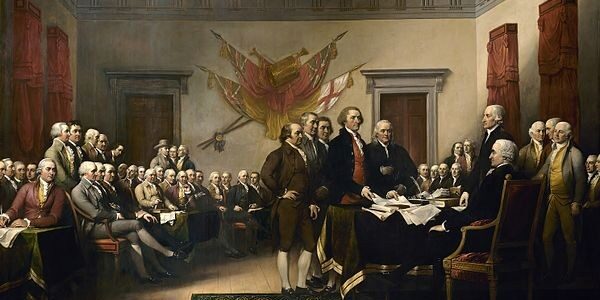
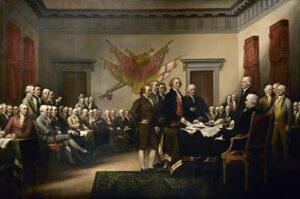
 This painting, one of five that hang in the Capitol Rotunda in Washington, D.C., depicts 42 of the 56 signers of the Declaration.
When John Trumbull returned to America in 1817 after many years abroad, he was commissioned by Congress to paint four large murals to be placed in the newly finished Capitol Rotunda. Trumbull, who had served under George Washington as his aide-to-camp, had made sketches of many of our Founders from his firsthand acquaintances. When he went to England after the war, he studied under the renowned artist Benjamin West.
In the famous painting above (hung in the Capitol in 1826), Trumbull depicts the Committee of Five (John Adams, Thomas Jefferson, Roger Sherman, Robert Livingston, and Benjamin Franklin) bringing forth their first draft of the Declaration of Independence on June 28, 1776. The painting only shows 42 of the 56 signers, because Trumbull could not obtain likenesses for all of them. He included some who had debated in Independence Hall but, for one reason or another, did not sign the Declaration.
The room he portrayed was more like Carpenter’s Hall, not the room where the document was actually signed. The men sitting in the room in the painting were never actually in the same room with each other at the same time, because they had had to flee for their lives and were not all elected to Congress at future sessions. By 1818, when this painting was commissioned, it was well-known to John Trumbull that many of the individuals who had signed the Declaration had sacrificed much on account of their signature. Bensing Lossing wrote in the “Introduction” of his book Lives of the Signers of the Declaration in 1848:
“The signing of that instrument was a solemn act, and required great firmness and patriotism in those who committed it. It was treason against the home government, yet perfect allegiance to the law of right. It subjected those who signed it to the danger of an ignominous death, yet it entitled them to the profound reverence of a disenthralled people.”
 The only names on the July 4 document were John Hancock, President of the Continental Congress, and Charles Thomson, Secretary.
Hancock had been willing to give up his wealth, and Thomson’s significant role was expressed by John Jay (who would later become first Chief Justice of the Supreme Court), who wrote on July 19, 1783: “No Person in the World is so perfectly acquainted with the Rise, Conduct, and Conclusion of the American Revolution, as yourself….”
President George Washington wrote a letter to Thomson on July 24, 1789, saying:
“The present age does so much justice to the unsullied reputation with which you have always conducted yourself in the execution of the duties of your Office, and Posterity will find your Name so honorably connected with the verification of such a multitude of astonishing facts, that my single suffrage would add little to the illustration of your merits… your Services have been important, as your patriotism was distinguished; and enjoy that best of all rewards, the consciousness of having done your duty well.”
On August 2, at the official signing of the Declaration in Philadelphia, the fact of pledging their “lives, fortunes and sacred honor” with their signature was beginning to be realized. Though the names of the signers were not officially made public until January 18, 1777, to protect them, their very presence as members of the Second Continental Congress made them targets of the British.
What happened to those who signed? Of the 56 delegates who eventually signed the Declaration, five were captured, tortured and killed; 12 had their homes ransacked and burned; two lost their sons and two more had their sons captured; nine fought and died from wounds; and the remaining individuals were fugitives and fled for their lives.
A month after ratifying the Declaration of Independence, Sam Adams, not known for his oratory, rose to speak about the moment they were in. In his speech, he declared:
“Courage then, my countrymen! Our contest is not only whether we ourselves shall be free, but whether there shall be left to mankind an asylum on earth, for civil and religious liberty! …We have this day restored the Sovereign, to whom alone men ought to be obedient. He reigns in Heaven, and with a propitious eye beholds his subjects assuming that freedom of thought, and dignity of self-direction which He bestowed upon them. From the rising to the setting sun, may His Kingdom come.”
From a biblical perspective, signing your name to a document is like a public confession. The Bible says that a result of confessing Jesus as Lord is our names being written in heaven. Having your name written in heaven often means a price to be paid on earth for such a confession. The martyrs of history prove this point, especially when the civil government in many countries makes it illegal for such a confession of Christ as Lord.
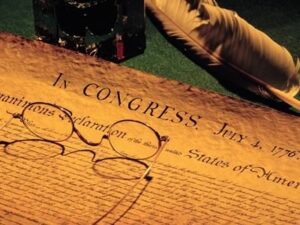 For years I have pondered the sacrifice made by the delegates in 1776. I have also realized that the legacy of the Declaration has influenced the nations with hope for liberty among those who only dream of freedom. One of my mentors, Rus Walton, Executive Director of the Plymouth Rock Foundation for more than two decades, wrote in his Letter from Plymouth Rock in 1981 these powerful words:
“So deeply were they committed to the principles that were the bedrock of the Declaration, so intensely were they given to the cause of liberty under God, that they willingly – enthusiastically – voted for and signed that document. They signed for their countrymen. They signed for us! To those who will take the time to study its wonder and ponder its message, it comes clear it is as much a Declaration of Dependence upon the Lord God as it is a Declaration of Independence from Civil Tyranny.” [emphasis added]
In this 250th year of contemplating the price of our liberty, let us ponder and agree with John Adams’ words when he wrote to his wife Abigail in 1777: “Posterity! You will never know, how much it cost the present Generation, to preserve your Freedom! I hope you will make a good Use of it.”