
 The intervention of the Providence of God is often not what we expect. To call a retreat a providential act of self-preservation may appear odd. If God is involved, shouldn’t it always be a victory? Today, it is a common strategy to remove all acts of God from history, even if those who experienced the event think the effects were miraculous. Reporting what people believed at the time is good scholarship regardless of whether the historian personally agrees. It allows each of us who read about the event to make up our own mind.
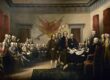
Historians recognize that soon after the Declaration of Independence was officially signed in early August of 1776, Washington’s troops faced certain defeat, and any hopes for achieving independence should have died with their surrender. Remembering this event is necessary for patriotic Americans to ponder. Regardless of how dark it appears, even a retreat to fight another day can be Providential!
Mark Beliles writes: “In 1776, the single most significant claim of God’s intervention by the Founders was in the retreat of the army from Long Island after a defeat. Sometimes, miracles do not bring victory, but simply survival.” After a massive lightning storm that killed several soldiers on the night of Wednesday, August 21, Major Abner Benedict, a Connecticut officer on Brooklyn Heights, wrote: “There seems hidden meaning, some secret purpose, when the bolt is launched by an invisible arm, and from the mysterious depth of space.” Was God trying to get their attention? We often miss the “invisible arm” of God warning, preparing, and leaving an impression of awe that He is in charge.
On Thursday, August 22, General Howe landed with up to 30,000 troops on the southern shore of Long Island. General Washington had about 10,000 troops at the time. Beliles writes:
“On the night of August 26-27, Howe executed a successful flanking maneuver. American units under John Sullivan and others were surprised, outflanked, and routed. Desperate rear-guard actions, notably by the Maryland and Delaware troops under William Alexander (Lord Stirling) – including the famous stand of the ‘Maryland 400’ – bought time for many to escape to the main defenses of Brooklyn Heights.”
David McCullough writes:
“Washington, watching from a Brooklyn hill, is said to have cried out as he saw the Marylanders cut down time after time, ‘Good God, what brave fellows I must this day lose?’ …To the British it was a ‘glorious day’ – ‘a cheap and complete victory’ in the terse summation of General Grant. ‘You will be glad,’ Grant wrote to General Harvey, ‘that we have had a field day I talked of in my last letter. If a good bleeding can bring those Bible-faced Yankees to their senses, the fever of independency should soon abate.’”
The British had fewer than 400 killed, wounded, or missing. The “rebel” losses were more than 3,000. A victory by an enemy can so discourage us, we are ready to give up. The despair of troops, routed after having won Dorchester Heights without any bloodshed, and having heard the lofty words of the Declaration, must have been truly devastating. But the Scriptures in Proverbs 24:16 give a long-range view, “For a righteous man may fall seven times and rise again, but the wicked shall fall by calamity.”
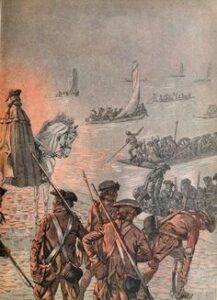
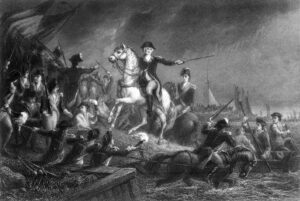 Washington made the only decision he could make. He would retreat secretly on Thursday night, August 29. It would be an impossible task, however. How do you silently move 9,000 troops, with artillery equipment, across a river a mile wide, with a rapid current, in the face of British warships?
The questions we must ponder today in memory of this remarkable feat are simple yet profound!
– Why did General Howe hold his position for two days without attacking the remaining troops?
– Who could have timed the reinforcements of a thousand men the day before the retreat, which included Colonel Glover’s regiment of Massachusetts fishermen and their sturdy boats?
– What caused a heavy rain to conceal the initial evacuation and the adverse winds against the British ships?
– What caused the northeast wind to stop and the water to be calm at 11 PM, with a gentle breeze to help the boats, now filled to the brim with soldiers and equipment, glide across the river?
– What caused the British to be blinded and deafened to this retreat under a full moon?
– As the sun rose, what caused an unusual fog to appear, “settling in a peculiar manner over both encampments,” that was so thick “I could scarcely discern a man at six yards’ distance” (so wrote Maj. Talmadge)?
– What would cause the fog to rise behind the last boat going across, which carried Washington?
– What caused a servant, who was sent to warn the British of the retreat, to be retained by the Hessians, since he could not be understood?
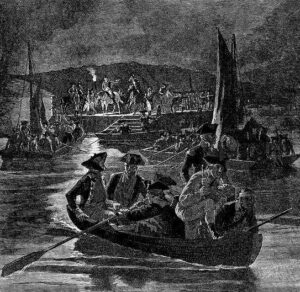 Washington Irving writes, less than a hundred years later, the answer to these questions:
“This extraordinary retreat, which, in its silence and celerity… was one of the most signal achievements of the war… redounded greatly to the reputation of Washington, who, we are told, for forty-eight hours preceding the safe extricating of his army from their perilous situation, scarce closed his eyes, and was the great part of the time on horseback. Many, however, who considered the variety of risks and dangers which surrounded the camp, and the apparently fortuitous circumstances which averted them all, were disposed to attribute the safe retreat of the patriot army to a peculiar Providence.”
Perhaps Washington’s warning to his troops on August 23 before the battle serves as a sober warning we all must heed in our day, especially as it relates to our spiritual battle against the forces of darkness:
“The hour is fast approaching, on which the honor and success of this army, and the safety of our bleeding country, depend. Remember, officers and soldiers, that you are free men, fighting for the blessings of liberty – that slavery will be your portion, and that of your posterity, if you do not acquit yourselves like men.”